


Tutorial: Best Ingredients That Help Dehydrated Skin
Your Cart
0You May Also Like
If your skin feels tight the moment you step out of the shower, or you notice dry patches showing up under your makeup by noon, you already know how frustrating dryness can be. It is not just a winter thing either. Air conditioning, hard water, over-cleansing, and even stress can strip your skin of moisture faster than it can replenish it. The good news is that dryness is one of the most well-understood skin concerns out there. Once you know which ingredients help dehydrated skin and why they work, building a routine that actually holds moisture becomes a lot more straightforward. That is the thinking behind how Asaya approaches hydration — ingredients that support your barrier, not disrupt it.
Dryness happens when your skin loses water faster than it can hold onto it — the fix is layering the right hydrating skincare ingredients in the right order.
Humectants draw water in, emollients smooth and soften, and occlusives seal it all in — you need all three working together for lasting hydration.
Ceramides and barrier repair ingredients are the real long-term solution for dry, flaky skin, not just a quick fix.
Your skin has a protective outer layer called the skin barrier. Think of it like a brick wall — skin cells are the bricks, and lipids like ceramides are the mortar holding everything together. When that mortar breaks down, water escapes from your skin into the air. This is called transepidermal water loss, and it is the main reason your skin feels tight, rough, or flaky.
A compromised barrier does not just cause dryness. It also makes your skin more reactive, more prone to irritation, and slower to recover from breakouts or dark spots. So when you are dealing with dryness, you are really dealing with a barrier that needs support, not just a surface that needs more cream.
Not all moisturizing agents for dry skin work the same way. There are three categories, and understanding them helps you build a routine that actually holds moisture in rather than just feeling good for an hour.
Humectants are ingredients that pull water toward your skin, either from the air around you or from deeper layers of the skin. Hyaluronic acid for dryness is probably the most well-known humectant — it can hold up to 1000 times its weight in water, which is why it shows up in so many serums and moisturizers. Glycerin for a dehydrated complexion works similarly and is often underrated. It is gentle, effective, and works well across all skin types, including sensitive skin. If you want to understand more about what sets dehydrated skin apart, this guide on dehydrated skin covers the key differences in detail.
Emollients fill in the gaps between skin cells, making the surface feel smoother and softer. They do not add water to your skin, but they make it easier for your skin to hold onto the water it already has. Ingredients like fatty acids and plant-based oils fall into this category. If you have rough, flaky patches, emollients are what actually smooth them out.
Occlusives sit on top of the skin and form a physical seal that slows down water loss. They are the last step in a hydration routine for a reason — they lock in everything underneath. Heavier creams and balms often contain occlusive ingredients. If you have very dry skin, especially in winter or in air-conditioned environments, an occlusive layer at night can make a noticeable difference by morning. For more on building a full dry skin routine around occlusive layering, this step-by-step hydration guide is a useful reference.
Beyond the three categories above, there are specific skin barrier repair ingredients that go a step further. They do not just hydrate — they help rebuild the barrier itself so your skin gets better at holding moisture over time.
Ceramides are lipids that naturally exist in your skin barrier. When your barrier is damaged, ceramide levels drop. Replenishing them topically helps restore the barrier's structure. It is worth noting that ceramide depletion can be accelerated by over-cleansing or using harsh actives too frequently, which is why the products you use before your moisturizer matter just as much as the moisturizer itself. Ceramides for dry skin are especially useful if your dryness is chronic or if your skin feels sensitive and reactive alongside being dry.
Niacinamide, or Vitamin B3, has been shown to stimulate ceramide synthesis in the skin, which directly supports barrier repair. It also helps regulate moisture levels and reduces redness — including the kind of post-inflammatory redness that often follows breakouts, which makes it particularly relevant for Indian skin tones that are more prone to lingering discolouration. It is one of those ingredients that works quietly in the background, making everything else in your routine work better.
If you are wondering how to fix dehydrated skin fast, the answer usually comes down to layering — not just which products you use, but the order you apply them. A good rule of thumb is to go from lightest to heaviest — humectants first, then emollients, then occlusives. Apply your hydrating serum or essence to slightly damp skin so the humectants have water to pull in. Follow with your moisturizer while the serum is still absorbing, and if you need extra protection at night, add a richer layer on top. For overnight repair, applying a richer occlusive layer after your moisturizer is one of the fastest ways to wake up with noticeably less tightness.
For dry skin specifically, skipping any of these steps tends to show up quickly — either as tightness by midday or as flakiness that no amount of foundation can cover. Consistency matters more than any single product.
The best ingredients for dry, flaky skin are not always the richest or heaviest ones. What matters is that your moisturizer contains a combination of humectants, emollients, and barrier-supporting ingredients — and that the texture works for your skin and climate. A thick cream that feels great in December might feel suffocating in a Mumbai summer.
The Asaya Moisture Cocoon Creme — Hydrating and Glow Moisturizer with Niacinamide is a good example of how this balance can work. It combines ceramides for barrier repair, niacinamide for moisture regulation, and watermelon extract for lightweight hydration — all in a featherlight, silky texture that does not feel heavy or greasy. It works well under makeup during the day and as an overnight treatment, which makes it practical for a consistent routine without needing to switch products between AM and PM.
If your skin leans oily but still feels dehydrated — which is more common than people think, especially in urban environments — the Asaya New Light Gel Face Moisturiser is worth considering. It uses hyaluronic acid and snow mushroom alongside five ceramides in an ultra-light water-gel format that absorbs quickly and does not leave any residue. It hydrates without adding shine, which is exactly what dehydrated, oily skin needs.
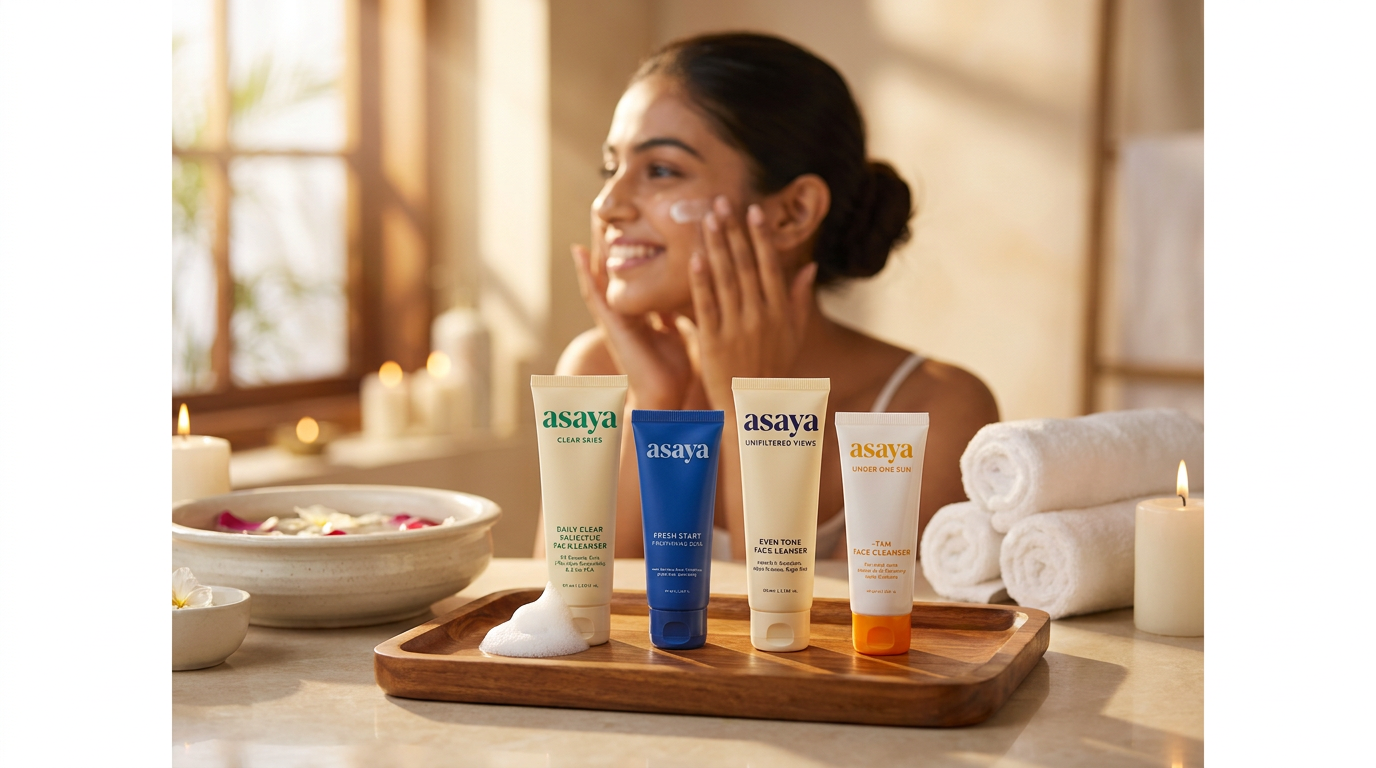
For those who want to address dryness and uneven skin tone at the same time, the Asaya Even Tone Face Cleanser is a practical starting point. It is a low-pH, non-stripping gel cleanser, which means it cleans without disrupting your barrier — something that matters a lot when your skin is already dry or sensitive. Starting with a cleanser that does not over-strip is one of the simplest ways to stop making dryness worse before you even get to your moisturizer.
Hyaluronic acid is the most effective starting point for dehydrated skin because it draws water into the skin and holds it there. Pair it with ceramides to repair the barrier and glycerin to maintain moisture levels throughout the day.
Dehydrated skin is low in water content, not oil. The skin barrier is often compromised, which means it loses water faster than it can retain it — a process called transepidermal water loss. Replenishing water content with humectants and supporting the barrier with ceramides addresses both sides of the problem.
Yes, and it is actually quite common. Oily skin produces excess sebum, but that does not mean it has enough water. Dehydration is about water content, not oil. If your skin looks shiny but feels tight or shows fine lines when you smile, it is likely dehydrated. Lightweight humectants like hyaluronic acid work well here without adding to the oiliness.
Absolutely. A hydrating serum with humectants like hyaluronic acid draws water into the skin, and a moisturizer with ceramides and emollients seals it in. Using both gives you better, longer-lasting hydration than either product alone. Apply the serum first on damp skin, then follow with your moisturizer while it is still absorbing.
Dryness is not a permanent state — it is usually a sign that your skin barrier needs more consistent support. Once you understand the difference between humectants, emollients, and occlusives, and start layering them in the right order, your skin's ability to hold onto moisture improves over time. The key is choosing ingredients that actually rebuild the barrier, not just mask the tightness temporarily.
Ceramides, niacinamide, hyaluronic acid, and glycerin are the workhorses here. They are well-researched, gentle enough for daily use, and effective across Indian skin tones and climates — which tend to swing between dry winters and humid summers in ways that generic global skincare rarely accounts for.
And if pigmentation or dark spots are part of the picture alongside dryness — which they often are, especially after breakouts or sun exposure — it is worth knowing about MelaMe™ Complex.
MelaMe™ Complex is Asaya's melanin-first molecule that works on existing dark spots by breaking down excess melanin deposits into re-absorbable amino acids, while also inhibiting further excess melanin production. It is designed specifically for melanin-rich skin and shows visible fading within two weeks of regular use. Addressing both dryness and discolouration together, rather than treating them as separate problems, tends to get you to even-toned, comfortable skin a lot faster.
