


How to Choose the Right Tinted SPF Shade
Your Cart
0You May Also Like

₹636 ₹749

₹424 ₹499

₹509 ₹599

₹594 ₹699

₹424 ₹499

₹466 ₹549
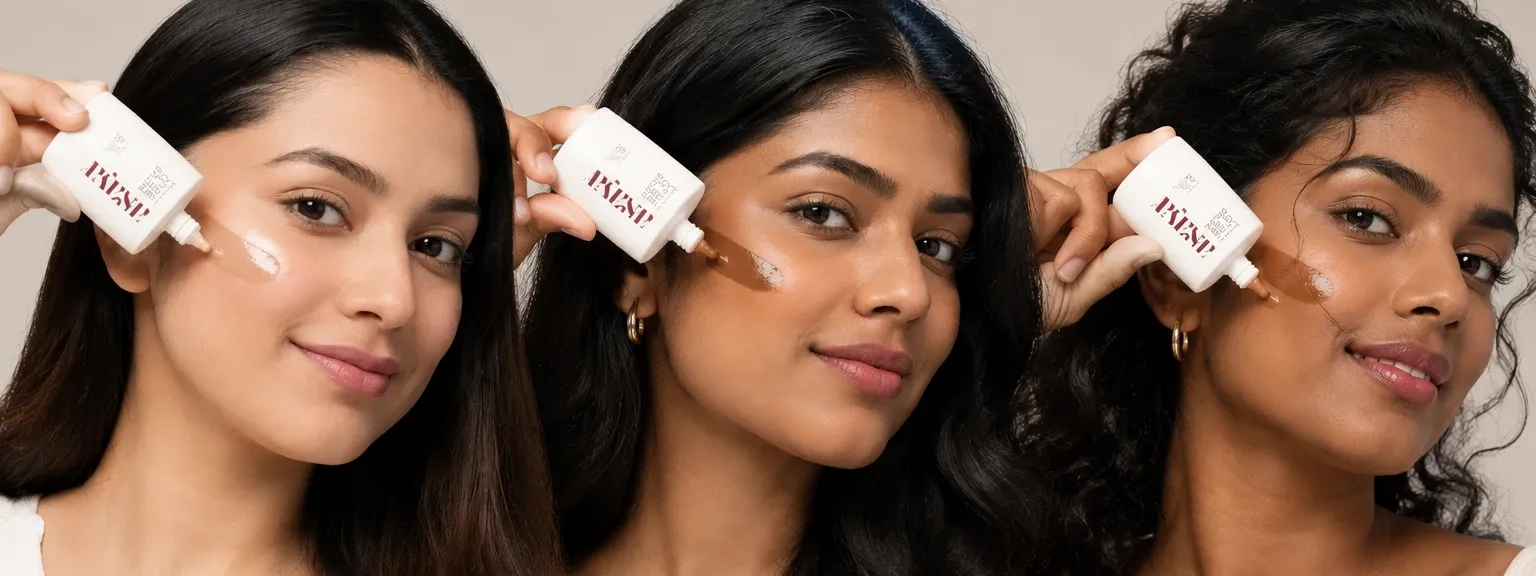
Tinted sunscreen sounds simple enough — SPF plus a little colour. But if you've ever ordered one online and received something that looked nothing like your skin, you know the struggle is real. If you're trying to figure out how to choose the right tinted SPF shade, the answer starts before you even look at swatches — it starts with your undertone. Finding your perfect tinted SPF isn't just about aesthetics. The wrong tint can look ashy, orange, or just off, which means you stop wearing it, which means your skin misses out on daily sun protection. The good news is that shade matching is actually pretty straightforward once you know what to look for — and Asaya's Hint of Tint range makes it easier with five shades built specifically for Indian skin tones.
Match your tinted sunscreen to your undertone first, then your depth of skin tone — this is the step most people skip.
Tinted SPFs offer sheer coverage, not full foundation coverage, so expect skin-evening, not skin-masking.
The right shade should disappear into your skin within 30 seconds of blending — if it doesn't, it's not your match.
Most sunscreen guides skip the shade conversation entirely. But for tinted SPF, getting the colour right is the difference between a product you reach for every morning and one that sits unused in your drawer. Tinted sunscreen shade matching isn't about finding a perfect foundation match — it's about finding a shade that blends seamlessly and adds a little evening-out without looking like a mask.
For Indian skin tones specifically, this matters even more. Many tinted SPFs on the market are formulated with Western skin tones in mind, which means the shade range skews too light or too pink. If you've dealt with a white cast or an orange tint before, that's likely why.
Before you think about how light or deep your skin is, figure out your undertone. Indian skin tones typically fall into warm (yellow, golden), neutral (a mix of warm and cool), or cool (pink, rosy) undertones. A quick way to check: look at the veins on your inner wrist. Greenish veins usually mean warm undertones, bluish-purple means cool, and a mix of both means neutral.
Once you know your undertone, match the depth — how light or deep your skin sits on the spectrum. Tinted sunscreens work best when the shade is one step lighter or an exact match to your natural skin tone, since they sheer out on application. If you've been searching for the best tinted moisturizer shade and landed on tinted SPF instead, the shade-matching logic is the same — undertone first, depth second.
Online shopping makes shade matching harder, but not impossible. The key is to use shade descriptions and undertone guidance rather than just looking at swatch photos on a screen — those vary wildly depending on the device you're viewing them on.
The Asaya Hint of Tint SPF 50 Tinted Sunscreen comes in five shades — 01 Dawn through 05 Moonbeam — designed to cover the range of Indian skin tones from fair to deep. Each shade is formulated with titanium oxides and 5% Niacinamide, so you're getting sun and blue-light defense alongside a breathable satin-matte finish that controls oil without feeling heavy. If you're between shades, go one lighter — tinted SPFs warm up slightly on the skin.
If your skin is on the lighter end with warm or neutral undertones, start with shades 01 or 02. These are formulated to give a natural, skin-like finish without pulling pink or grey on lighter Indian skin.
For medium to deep skin tones, shades 03 through 05 are your range. These are built to avoid the ashiness that most tinted SPFs leave on deeper skin — a common complaint that comes from formulas not designed with melanin-rich skin in mind.
Tinted sunscreen coverage is sheer, not full. Think of it as your skin, but more even — it softens redness, blurs minor texture, and gives a unified tone without sitting on top of your skin the way a foundation does. If you're dealing with active breakouts or deeper dark spots, a tinted SPF won't cover those completely, and that's fine. It's doing a different job. For days when you want a little more coverage, layer a light concealer underneath and let the tinted SPF go on top as your finishing step.
Apply to clean, moisturised skin — dry patches make tinted SPF look patchy and uneven.
Dot it across your face first, then blend outward using your fingers or a damp sponge for the most natural finish.
Reapply every two hours if you're outdoors — the Asaya Sheerscreen Mist SPF 50+ works well here since it's a clear spray that goes on over makeup without smudging your tint.
A tinted sunscreen works best as the last step in your morning routine. What goes underneath matters too, especially if pigmentation or uneven tone is something you're working on. The Asaya Even Tone Face Cleanser is a good starting point — its MelaMe™ Complex, Alpha Arbutin, and Niacinamide work on uneven tone from the first step, so your tinted SPF has less to do by the time it goes on. The more consistently you use melanin-inhibiting actives underneath, the less visible unevenness your tinted SPF needs to cover — which means a more natural, skin-like finish over time.
Start with your undertone — warm, neutral, or cool — and then match your depth. The Asaya Hint of Tint SPF 50 Tinted Sunscreen range runs from shade 01 Dawn to 05 Moonbeam, covering fair to deep Indian skin tones. If you're unsure, go one shade lighter than you think, since the formula warms up slightly on application and sheers out as you blend.
It can, as long as the formula is designed for it. The Asaya Hint of Tint SPF 50 Tinted Sunscreen is a good example — its satin-matte finish and 5% Niacinamide are specifically designed to control oil without clogging pores. Avoid tinted SPFs with a dewy or luminous finish if your skin tends to get shiny by midday.
Go one shade lighter if you're unsure. Tinted SPFs warm up slightly on skin and sheer out as you blend, so a shade that looks slightly light in the bottle usually lands closer to your natural tone once applied.
Look for SPF 50 PA++++ with a formula built for warm and neutral undertones — most global SPFs skew too pink or too light for Indian skin. PA++++ is the highest rating for UVA protection — the kind of UV that causes dark spots and long-term skin damage — so it's worth checking for that specifically. The Asaya Hint of Tint range is specifically formulated for Indian skin tones across five shades.
Getting your tinted sunscreen shade right comes down to two things: knowing your undertone and understanding that tinted SPF is sheer by design. Once you stop expecting it to work like a foundation, it becomes one of the most useful products in a morning routine — sun protection, a little colour correction, and a skin-evening finish, all in one step.
If pigmentation or dark spots are part of what you're trying to even out, it's worth looking at what your SPF is doing beyond just blocking UV. The Asaya Spot Light Sunscreen SPF 50 PA++++ contains MelaMe™ Complex — Asaya's melanin-first molecule that, in clinical testing, works by breaking down existing melanin deposits into re-absorbable amino acids while inhibiting new melanin production. Most people see visible fading in about two weeks with consistent use. Pairing a pigment-correcting SPF with the right tinted option on days you want a little coverage means your routine is working on your skin even when it looks like you're doing nothing at all.
