


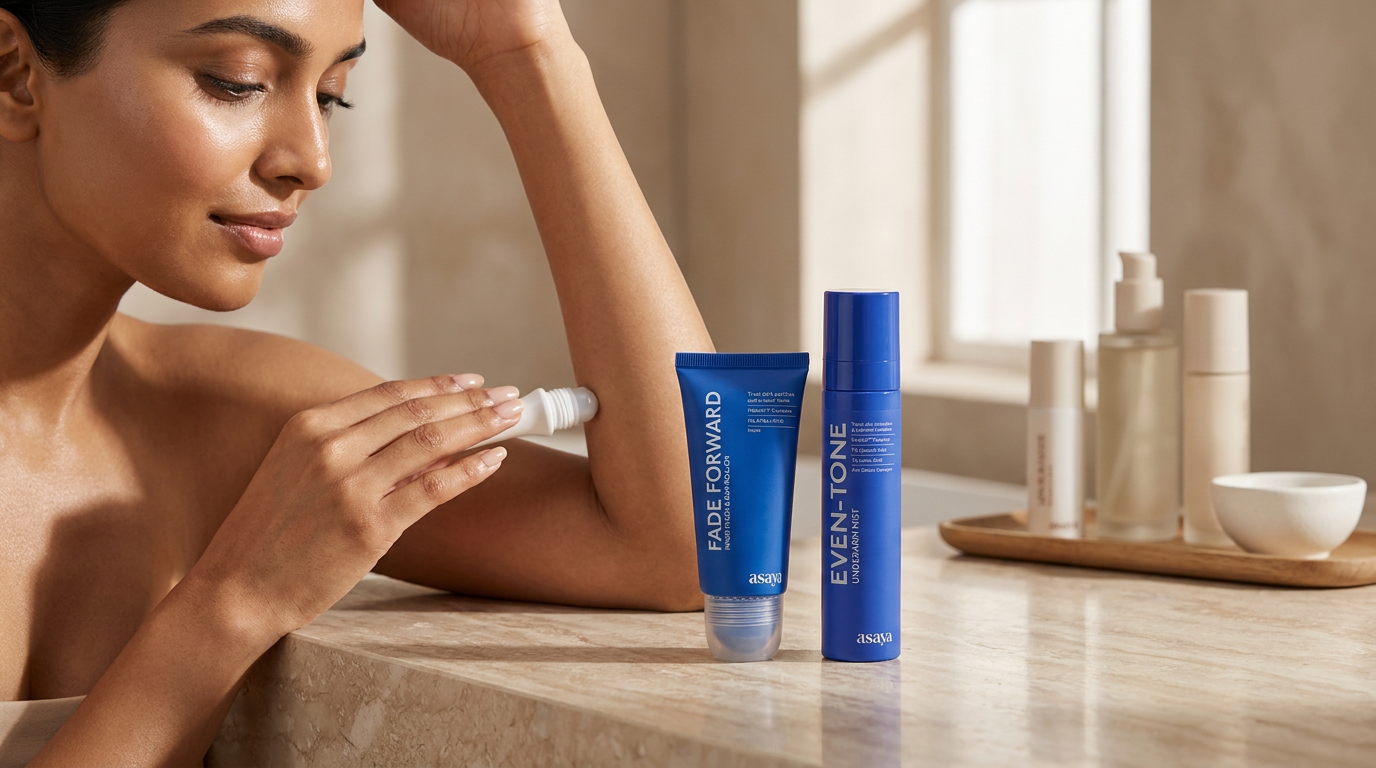
AHA and PHA exfoliants work differently on body skin than face skin. Learn how these chemical exfoliants fade dark spots, smooth texture, and even out tone on melanin-rich skin—without the irritation. Asaya breaks down what each does, how to use them safely, and which one suits your body skin concerns.
Featured AHA and PHA on body skin what they do Collection
AHA and PHA exfoliants are game-changers for body skin, especially if you're dealing with dark spots, rough texture, or uneven tone. Asaya explains what these chemical exfoliants actually do, how they work on melanin-rich skin, and how to use them without overdoing it.
What Are AHA and PHA Exfoliants?
AHA stands for alpha hydroxy acid, and PHA stands for polyhydroxy acid. Both are chemical exfoliants that dissolve the bonds holding dead skin cells together, letting them shed away naturally. The difference is in how deep they work and how fast they work. AHAs like glycolic acid and lactic acid are smaller molecules, so they penetrate faster and work stronger. PHAs like gluconolactone are larger molecules, so they work more gently and are less likely to irritate. On body skin, which is thicker than face skin, both can be effective—it just depends on your skin's tolerance and what you're trying to fix.
How They Fade Dark Spots and Even Tone
Dark spots on your body happen the same way they do on your face: your skin produces extra melanin in one spot, usually after sun exposure, irritation, or a breakout. AHAs and PHAs speed up cell turnover, which means the darker, pigmented cells on the surface shed faster. This reveals fresher, lighter skin underneath. Most people see visible fading in about 3 to 4 weeks with consistent use. The key is using them regularly but not overdoing it—body skin can handle exfoliation more often than face skin, but that doesn't mean daily use is better. Two to three times a week is usually the sweet spot.
AHA vs. PHA: Which One for Body Skin?
If your body skin is resilient and you want faster results on dark spots, AHA is the stronger choice. Glycolic acid and lactic acid work quickly and are backed by solid research on pigmentation. If your body skin is sensitive, easily irritated, or you're new to chemical exfoliants, PHA is the gentler entry point. It still fades spots and evens tone, just a bit slower. You can also layer them—use PHA a few times a week, and add an AHA once a week as your skin builds tolerance. Always patch test first, especially if you have a history of irritation or sensitivity.
How to Use Them Safely on Body Skin
Start low and go slow. If you're using an AHA or PHA serum or body wash, begin with once or twice a week and see how your skin responds. After a week or two, you can increase to two or three times weekly if your skin feels good—no redness, stinging, or dryness. Always follow up with a hydrating moisturizer and sunscreen during the day, because exfoliants make your skin more sun-sensitive. At night, you can skip sunscreen, but don't skip the moisturizer. If you're using a body lotion with AHA or PHA already mixed in, you can use it more frequently because the concentration is lower. Read the label to know what you're working with.
Q: Can I use AHA and PHA at the same time?
A: Not on the same day, especially when you're starting out. Layer them on different days—use AHA on Monday and Wednesday, PHA on Tuesday and Thursday, for example. Once your skin is used to both, you might be able to use them back-to-back, but there's no real benefit to doing that. Spacing them out gives your skin recovery time and reduces irritation risk.
Q: How long does it take to see results on dark spots?
A: Most people notice visible fading in 3 to 4 weeks with consistent use, two to three times a week. Dark spots take time to form, so they take time to fade too. If you're not seeing any change after 6 weeks, you might need a stronger concentration, or you might benefit from layering with a targeted dark spot serum that has ingredients like kojic acid or alpha arbutin alongside your exfoliant.
Q: Is body skin different from face skin when it comes to exfoliation?
A: Yes. Body skin is thicker and has fewer oil glands, so it's generally more resilient and can handle exfoliation more often than face skin. That said, the skin on your chest, neck, and inner arms is thinner and more delicate, so ease up on those areas. Hands, legs, and back can tolerate stronger or more frequent exfoliation.
Q: What should I do if my body skin gets irritated?
A: Stop using the exfoliant immediately and go back to a gentle routine—just cleanser, moisturizer, and sunscreen—for a few days. Once the irritation settles, you can try again at a lower frequency, like once a week instead of twice. If irritation comes back, switch to the gentler option (PHA instead of AHA) or look for a lower concentration. Never push through irritation; it's your skin telling you to slow down.
Q: Can I use AHA or PHA if I have acne scars on my body?
A: Chemical exfoliants help with surface texture and discoloration, but they won't fill in deep acne scars. What they can do is fade the dark marks left behind by old breakouts. If you have both dark marks and textured scars, exfoliating regularly will help with the marks, and you might want to talk to a dermatologist about other options for the deeper scarring, like microneedling or laser treatments.
