


What Actually Works for Fading Tan & Pigmentation on Indian Skin
Your Cart
0You May Also Like
If you are asking, 'How to remove tan and pigmentation marks from my face completely,' the honest answer is that tan and dark spots need different care. A tan is your skin's response to UV exposure. Dark spots can also follow acne, irritation, or sun exposure. On melanin rich skin, both can leave uneven skin tone that lasts longer than expected. That is why harsh scrubs and quick fixes often backfire. A calm routine, daily sun protection, and targeted actives make more sense. Asaya builds its pigmentation care around this reality, with formulas designed for Indian skin and the way it responds to excess melanin.
Tan usually fades with time and sun protection. Acne marks and other dark spots need targeted care.
Use gentle melanin regulating actives, avoid irritation, and wear SPF daily.
Skip lemon and aggressive exfoliation. They can trigger more dark spots.
Tan and dark spots may look alike, but they do not start the same way. UV exposure causes a temporary rise in melanin, which makes skin look darker. Post inflammatory hyperpigmentation, or PIH, forms after acne, irritation, or injury. What dermatologists call post-inflammatory hyperpigmentation, or PIH, is a deeper melanin response that does not fade with sun avoidance alone. Indian and other melanin-rich skin types are particularly prone to both triggers because higher baseline melanin levels mean the skin's pigment-producing cells, melanocytes, react more readily to UV and inflammation. Understanding this difference matters because the wrong approach — one that stings, strips, or over-exfoliates — can deepen dark spots on face instead of fading them.
Indian skin can produce extra melanin after both triggers. So a routine that stings, dries, or over exfoliates may deepen dark spots on face instead of fading them.
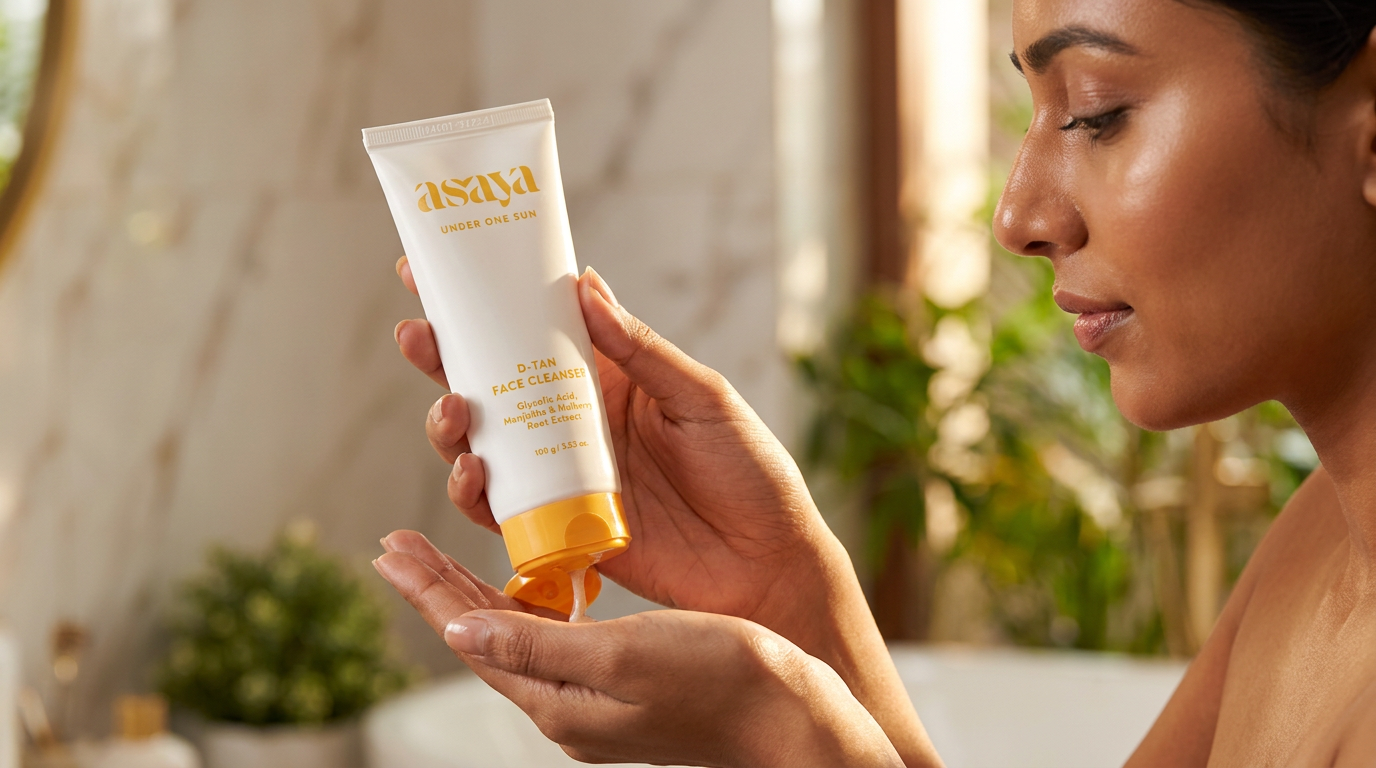
A sun tan is a broad darkening caused by UV exposure. It fades as skin renews itself, provided new sun exposure is limited. A gentle cleanser such as Asaya D Tan Face Cleanser can support a routine for sun induced dullness without harsh scrubbing.
Acne marks are often PIH, not scars. They can stay after the breakout has healed because melanin remains concentrated in that area. Acne marks removal needs patience, daily protection, and ingredients that support melanin regulation.
Choose a few proven active types instead of layering many strong products. Niacinamide, alpha arbutin, vitamin C, and gentle acids are often used for dark spots. Asaya's formulations focus on niacinamide, alpha arbutin, and MelaMe™ Complex as its chosen actives for melanin-rich skin, rather than layering too many strong ingredients at once — which can cause irritation and trigger more dark spots. Your skin should feel comfortable, not sore or tight.
Patch test new products. Add one active at a time, especially if you have active acne or sensitive skin.
Scientifically, tan fades as UV-triggered melanin disperses during natural skin cell turnover, which takes roughly 2-4 weeks.
Niacinamide and alpha arbutin are useful options for uneven tone and dark spots. Asaya Advanced Spot Targeting Serum combines 5% niacinamide, 2% alpha arbutin, and MelaMe™ Complex in a daily leave on format. Use it consistently rather than chasing overnight change.
AHAs and BHAs help lift dead skin cells and support smoother looking tone. But too much exfoliation can cause irritation induced PIH. Asaya Super Fade Regenerative Peel contains a 30% combined AHA, BHA, and PHA blend, so use it as a weekly wash off step, not a daily treatment.
Aloe vera may feel soothing, and yoghurt may feel soft on skin. But home mixes are not a reliable treatment for stubborn dark spots. Tomato and multani mitti can also be drying for some skin types.
Do not use lemon or other citrus directly on your face. Citrus can irritate skin and may make dark spots worse after sun exposure. Skin brightening should not come at the cost of a damaged barrier.
A pigmentation cream should support your skin barrier as well as target dark spots. Look for ingredients such as niacinamide, alpha arbutin, ceramides, and melanin focused actives. Avoid products that cause burning, peeling, or sudden sensitivity.
Be careful with products containing mercury, high strength steroids, or misused hydroquinone. These need informed medical guidance. For daily moisture, Asaya Even Evermore Creme pairs ceramides, alpha arbutin, and MelaMe™ Complex for dark spots and tone imbalance.
Clinical options can include chemical peels and laser toning. They may suit persistent dark spots, but deeper skin tones need careful treatment planning. Poorly managed procedures can trigger post peel PIH.
See a qualified skin professional if spots are spreading, changing, or not improving with gentle home care. Tell them about every active you use. This helps reduce avoidable irritation before a procedure.
No dark spot routine can do much if fresh UV exposure keeps adding melanin. Use sunscreen every morning and reapply during outdoor exposure. Choose SPF 50 and PA++++ when available, especially in strong sun.
In Asaya's Rapid Dark Spot Correction Set, Spot Light Sunscreen SPF 50 PA++++ sits alongside a cleanser, targeted gel, and moisturiser. That order matters: protect skin while you work on existing spots.
There is no safe five minute method to remove tan from face. A tan can fade gradually with skin renewal, sun avoidance, and gentle care. PIH and deep acne marks usually take longer because the pigment is more concentrated.
Consistency matters more than intensity. Asaya notes visible results from about two weeks for its Advanced Spot Targeting Serum and Advanced Spot Targeting Gel. Results can vary with the type of spot, sun exposure, and how well your skin tolerates the routine.
A UV tan can fade as skin renews, but no routine can promise a complete result. Sun protection and steady care give your skin the best chance to return to its usual tone.
Many Korean skincare routines focus on sunscreen, niacinamide, and layered brightening care. But Indian skin tone goals and melanin response differ, so choose products based on your own skin's needs. If you are looking for a routine built for Indian skin specifically, Asaya's MelaMe-powered serums are a good starting point.
Yes, a UV tan can fade and skin can become lighter or return closer to its natural tone over time. PIH takes longer and needs targeted actives, not just time. If you use Asaya Advanced Spot Targeting Gel, apply it as a targeted leave on step for post breakout marks.
Use gentle exfoliation, melanin regulating actives, and daily SPF. Avoid lemon, rough scrubs, and frequent strong peels. If you need moisture too, Asaya Even Evermore Creme can support a simple treatment routine.
Tan is temporary darkening. Dark spots are a longer melanin response, often linked to acne or irritation. Treat both gently, protect your skin daily, and give the routine time to work.
That's where the formulation behind Asaya's products matters — specifically MelaMe™ Complex. Asaya's MelaMe™ Complex is an advanced, skincare engineered, melanin first molecule designed to visibly treat discolouration and restore pigment balance within two weeks of regular use. It is tested and proven. It works on existing dark spots by breaking excess melanin deposits into re absorbable amino acids. It also inhibits excess melanin production, helping fade and prevent blemishes while supporting clearer, more even toned skin.
