


How to Overcome Hyperpigmentation on Your Face
Your Cart
0You May Also Like
If you've ever looked in the mirror and noticed patches of skin that are darker than the rest — around your cheeks, forehead, or along old breakout spots — you're not imagining things, and you're definitely not alone. If you're wondering how to overcome hyperpigmentation on your face, the short answer is: the right actives, applied consistently, with SPF every morning. Hyperpigmentation is one of the most common skin concerns for people with Indian and melanin-rich skin tones, and yet it's also one of the most misunderstood. The good news is that once you understand what's actually happening under the surface, it becomes a lot easier to deal with. Asaya was built around exactly this — skincare that takes melanin-rich skin seriously, not as an afterthought.
Hyperpigmentation happens when your skin produces too much melanin in one spot — triggered by sun exposure, breakouts, or inflammation.
The right actives (like Kojic Acid, Alpha Arbutin, Vitamin C, and Niacinamide) can visibly fade dark spots with consistent use — recent surface-level spots may begin fading in 2–4 weeks, while deeper pigmentation like melasma typically takes 2–3 months of consistent use.
Melanin-rich skin needs targeted, gentle formulas — not generic brightening products that weren't made with your skin tone in mind.
Dark spots happen when your skin produces extra melanin in one area — usually in response to something that irritated or stressed it. That could be a pimple, a patch of sun damage, friction, or even a small cut. Your skin is trying to protect itself, and melanin is part of that defence. The result is a spot or patch that's darker than your surrounding skin.
For people with deeper skin tones, this response tends to be stronger. Melanin-rich skin has more active melanocytes — the cells that produce melanin — which means any trigger can leave a more visible mark. That's not a flaw. It's just how your skin is wired, and it's worth knowing so you can work with it instead of against it.
Post-inflammatory hyperpigmentation (PIH) is what's left behind after a breakout or skin irritation heals. Melasma shows up as larger, symmetrical patches — often on the cheeks and forehead — and is closely linked to hormones and sun exposure. Sun spots are smaller, scattered marks from UV damage over time. All three are forms of hyperpigmentation, and all three respond to similar treatments — just at different speeds.
Most brightening products on the market were formulated with lighter skin tones in mind. That's a real problem, because melanin-rich skin reacts differently — both to triggers and to treatments. Harsh actives that work fine on lower-melanin skin can actually cause more inflammation on deeper tones, which leads to more dark spots. It's a frustrating cycle.
This is why the concentration, pH, and combination of ingredients matter so much. Gentle, targeted formulas that inhibit melanin production without irritating the skin are what actually work here. And consistency matters more than intensity — slow and steady genuinely wins this race.
A few ingredients have solid evidence behind them for fading dark spots. Kojic Acid blocks the enzyme that triggers melanin production. Alpha Arbutin works by blocking melanin synthesis at a different receptor — and because Kojic Acid and Alpha Arbutin target the melanin pathway from two distinct angles, combining both tends to outperform using either ingredient alone. Niacinamide reduces the transfer of melanin to the skin's surface. Vitamin C is a strong antioxidant that also brightens and protects. It's also worth noting that Kojic Acid (derived from fermented rice) and Alpha Arbutin (derived from bearberry) are naturally sourced actives — so while there are no instant natural cures for pigmentation, these ingredients offer plant-derived origins alongside clinical evidence. AHAs help by gently exfoliating the top layer of skin, which speeds up the fading process.
A good routine for dark spots doesn't need to be complicated — it needs to be consistent. For melanin-rich skin especially, that consistency is what separates real results from stalled progress, because the skin's heightened melanocyte activity means any gap in treatment can allow pigmentation to reassert itself. The basics are: a gentle cleanser that doesn't strip your skin, a targeted serum with melanin-inhibiting actives, a moisturiser to keep your barrier healthy, and sunscreen every single morning — without exception. Skipping SPF while treating dark spots is like trying to fill a bucket with a hole in it.
The Asaya Even Tone Face Cleanser is a low-pH gel cleanser that removes makeup and SPF without stripping your skin. It contains MelaMe™ Complex, Alpha Arbutin, Kojic Acid, and Niacinamide — so even your cleansing step is doing some work on dark spots and acne marks. It's a small shift that adds up over time.
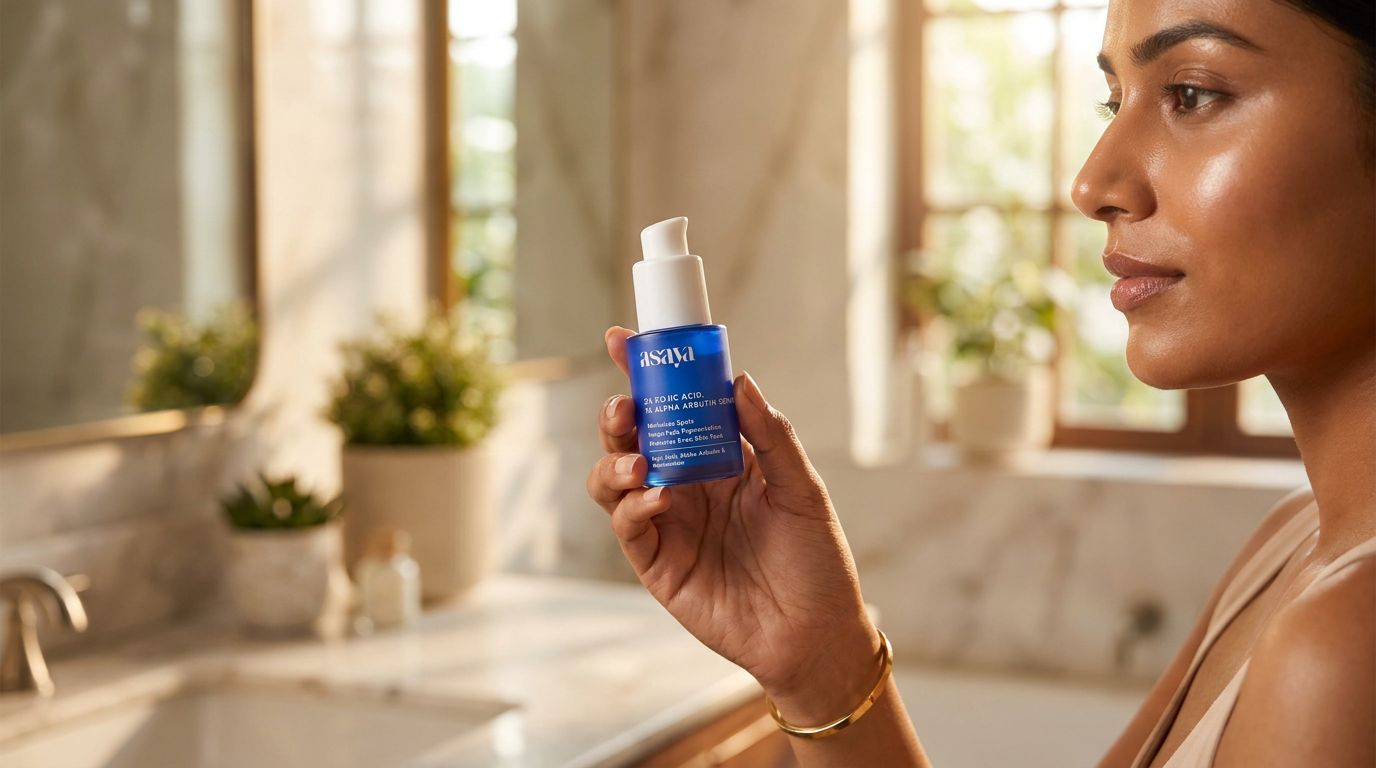
For facial dark spots removal, a serum is where most of the heavy lifting happens. The Asaya 2% Kojic Acid and 1% Alpha Arbutin Serum combines two of the most effective melanin-inhibiting actives in one gentle formula. It works well for post-inflammatory hyperpigmentation, sun-induced dullness, and melasma-type discoloration. Use it daily, and give it at least two to four weeks before expecting visible change — that's not a caveat, that's just how skin cell turnover works.
If sun damage and dullness are part of your concern, the Asaya 15% Vitamin C + E Serum with Ferulic Acid is worth adding to your morning routine. The Vitamin C and E combination, stabilised by Ferulic Acid, works against oxidative stress from UV and pollution — both of which make dark spots worse. It also supports collagen, which helps with overall skin texture over time.
A moisturiser is a non-negotiable part of any treatment routine — it keeps your skin barrier intact so actives can do their job without causing dryness or irritation. The Asaya Even Evermore Creme is formulated to work alongside melanin-inhibiting actives, providing the hydration your skin needs at each step without interfering with the treatment process. It completes the routine and helps your skin stay resilient through consistent use.
Dark spots don't stop at your jawline. Friction, sweat, and repeated irritation cause pigmentation on underarms, knees, elbows, and the neck too — and these areas are often ignored in standard skincare conversations. The skin here is thicker and more stubborn, which means it needs actives that can actually penetrate and work.
The Asaya Tone Restore Knee-Neck-Elbow Cream uses MelaMe™ Complex alongside Kojic Acid, AHAs, and Urea to address both the pigmentation and the rough texture that often comes with it. Urea is particularly useful here — it softens and hydrates thickened skin, which helps the other actives absorb better. For underarms, the Asaya Even Tone Underarm Mist combines a 10% AHA blend with MelaMe™ Complex and an anti-odour complex, so it handles dark patches and odour in one step.
It depends on how deep the pigmentation is and how consistently you're treating it. Surface-level dark spots from recent breakouts can start fading in two to four weeks with the right actives. Deeper pigmentation — like long-standing melasma or old sun spots — takes longer, sometimes two to three months of consistent use. The key word is consistent. Skipping days slows everything down.
Yes, but layering matters. Some combinations work well together — like Kojic Acid and Alpha Arbutin, or Niacinamide and Vitamin C at the concentrations used in most leave-on formulas. Others can cause irritation if used at the same time, like AHAs and Vitamin C in the same step. A simple rule: use your actives at different times of day if you're unsure, and always follow with SPF in the morning.
It's formulated to be gentle, which makes it a reasonable starting point even for skin that tends to react. That said, if your skin is very reactive, start with every other day and build up. Watch for any redness or stinging — that's your skin telling you to slow down, not push through.
Yes, without question. UV exposure is one of the main triggers for melanin production. If you're using actives to fade dark spots but skipping SPF, the sun is undoing your progress in real time. Sunscreen isn't optional in a hyperpigmentation routine — it's the step that makes everything else work.
Korean skincare approaches hyperpigmentation through a combination of low-pH cleansing, layered actives, and non-negotiable daily SPF use. The philosophy prioritises gentle, consistent treatment over aggressive intervention — keeping the skin barrier intact while steadily inhibiting melanin production. The Asaya Even Tone Face Cleanser is formulated in Korea and applies exactly this approach: a low-pH gel formula that cleanses without stripping, while actives like Alpha Arbutin, Kojic Acid, and Niacinamide work on dark spots from the very first step of your routine.
Hyperpigmentation is common, it's manageable, and it's not something you need to feel frustrated about forever. The right combination of actives, applied consistently, with sunscreen every morning — that's genuinely all it takes. It's not glamorous advice, but it's honest.
What makes a real difference for melanin-rich skin specifically is using formulas that were designed with that skin in mind. Asaya's MelaMe™ Complex is built around exactly this — a melanin-first molecule that works on existing dark spots by breaking down excess melanin deposits into re-absorbable amino acids, while also inhibiting further melanin overproduction. It fades what's already there and helps prevent new spots from forming.
Most people see visible fading within two weeks of regular use. That's based on clinical testing, not a marketing claim. If pigmentation has been a persistent frustration, starting with the right science behind your routine makes all the difference.
