


7 Ways Sunscreen Prevents Dark Spots and Hyperpigmentation
Your Cart
0You May Also Like
If you've been dealing with dark spots that just won't budge, you're not alone. Hyperpigmentation is one of the most common skin concerns for people with Indian and melanin-rich skin tones — and one of the most misunderstood. You treat the acne, the breakout clears, and then a dark mark shows up in its place and stays for months. Or you spend a summer outdoors and come back with uneven patches that no amount of face wash seems to shift. The frustrating part isn't just the spots themselves — it's that most products weren't built with your skin tone in mind. Asaya was. And a big part of what makes any pigmentation routine actually work is something most people underestimate: sunscreen.
Hyperpigmentation gets worse with UV exposure — sunscreen isn't optional, it's the foundation of any dark spot routine.
The right sunscreen for hyperpigmentation does more than block UV — it can actively help fade existing spots when formulated with the right actives.
Pairing SPF with targeted serums and cleansers gives you the best shot at visible, lasting results.
Sunscreen prevents UV rays from triggering excess melanin production, which is the root cause of most dark spots and hyperpigmentation. It also stops existing spots from deepening, which means your brightening actives can actually do their job. Without daily SPF, even the best serum is working against UV exposure every morning.
Here's the thing about dark spots: UV exposure doesn't just cause them, it actively makes existing ones darker. When UV rays hit your skin, they trigger melanin production as a defence response. If you already have areas of excess melanin — from a past breakout, hormonal changes, or sun damage — those spots absorb even more UV and deepen further. So if you're using a brightening serum every night but skipping SPF in the morning, you're essentially undoing your own work.
Sunscreen for hyperpigmentation isn't a bonus step. It's the step that makes everything else in your routine actually stick. Think of it as locking in the progress your actives are making overnight, so the sun can't reverse it by noon.
Your skin produces melanin in response to UV as a way to protect itself. In melanin-rich skin, this response is stronger and faster — which is why post-inflammatory hyperpigmentation (PIH) and sun spots tend to be more pronounced and longer-lasting. Broad-spectrum SPF 50 PA++++ blocks both UVA (the rays that age and pigment) and UVB (the rays that burn), giving your skin the protection it needs to stop the cycle.
Every time UV rays reach your skin, they signal melanocytes to produce more melanin. In melanin-rich skin tones, this response is amplified. Daily broad-spectrum SPF 50 PA++++ intercepts that signal before it starts, reducing the stimulus that causes dark spots to form in the first place.
Areas of existing hyperpigmentation absorb UV more readily than surrounding skin, which means they darken faster with each exposure. Sunscreen creates a barrier that stops this cycle, allowing your current spots to stabilise rather than intensify while your actives work to fade them.
Brightening ingredients like Kojic Acid, Alpha Arbutin, and Vitamin C are doing their job overnight — but UV exposure in the morning can undo that progress within hours. SPF protects the work your serums are doing, so the results actually accumulate over time instead of being reversed daily.
UVA rays penetrate deeper into the skin than UVB and are present year-round, even on cloudy days. They're a primary driver of photoaging and long-term pigmentation changes. A broad-spectrum SPF with high PA++++ rating specifically addresses UVA, which standard SPF numbers alone don't reflect.
Tinted sunscreens containing iron oxides offer protection against visible light and blue light — both of which can trigger pigmentation, particularly in melasma-prone skin. If your hyperpigmentation is hormonally driven or especially stubborn, a tinted SPF adds a layer of defence that untinted formulas don't provide.
Post-inflammatory hyperpigmentation forms when skin inflammation — from acne, friction, or irritation — triggers excess melanin. UV exposure after a breakout significantly worsens the resulting dark mark. Consistent SPF use reduces the severity of PIH and lowers the chance of new marks forming after future breakouts.
Your skin naturally replaces pigmented cells through cell turnover — but UV keeps re-triggering melanin production in those areas, slowing visible fading. When you remove the UV stimulus with daily SPF, your skin's own renewal process can gradually replace dark spots with new, evenly pigmented cells.
Preventing dark spots with sunscreen is about more than just avoiding new ones. When you wear SPF daily, you stop the UV stimulus that keeps existing spots from fading. Your skin's natural cell turnover can then do its job — gradually replacing pigmented cells with new ones — without UV constantly re-triggering melanin production in those areas.
Most people notice a visible difference in their overall skin tone within a few weeks of consistent SPF use, especially when it's paired with actives. That's not a miracle — it's just what happens when you stop the thing that was working against you.
Not all sunscreens are built the same, and the one that works for your friend with dry skin might not work for you if you're oily or acne-prone. The good news is that there are genuinely good options now that don't leave a white cast, don't feel heavy, and don't break you out — which used to be the main complaints about SPF on Indian skin tones.
The key is finding a formula that suits your skin's texture and concerns, so you'll actually wear it every day. Because the best sunscreen is the one you use consistently.
If your skin gets shiny by mid-morning, a matte-finish SPF is your best bet. The Asaya Sheer Milk Sunscreen SPF 50 Matte Fluid Sunscreen is formulated specifically for oily, acne-prone, and combination skin. It's ultra-light, leaves no white cast, and contains Niacinamide and Vitamin C — so it's doing double duty as a brightening step while protecting against UV. It sits well under makeup too, which matters when you're getting ready in a hurry.
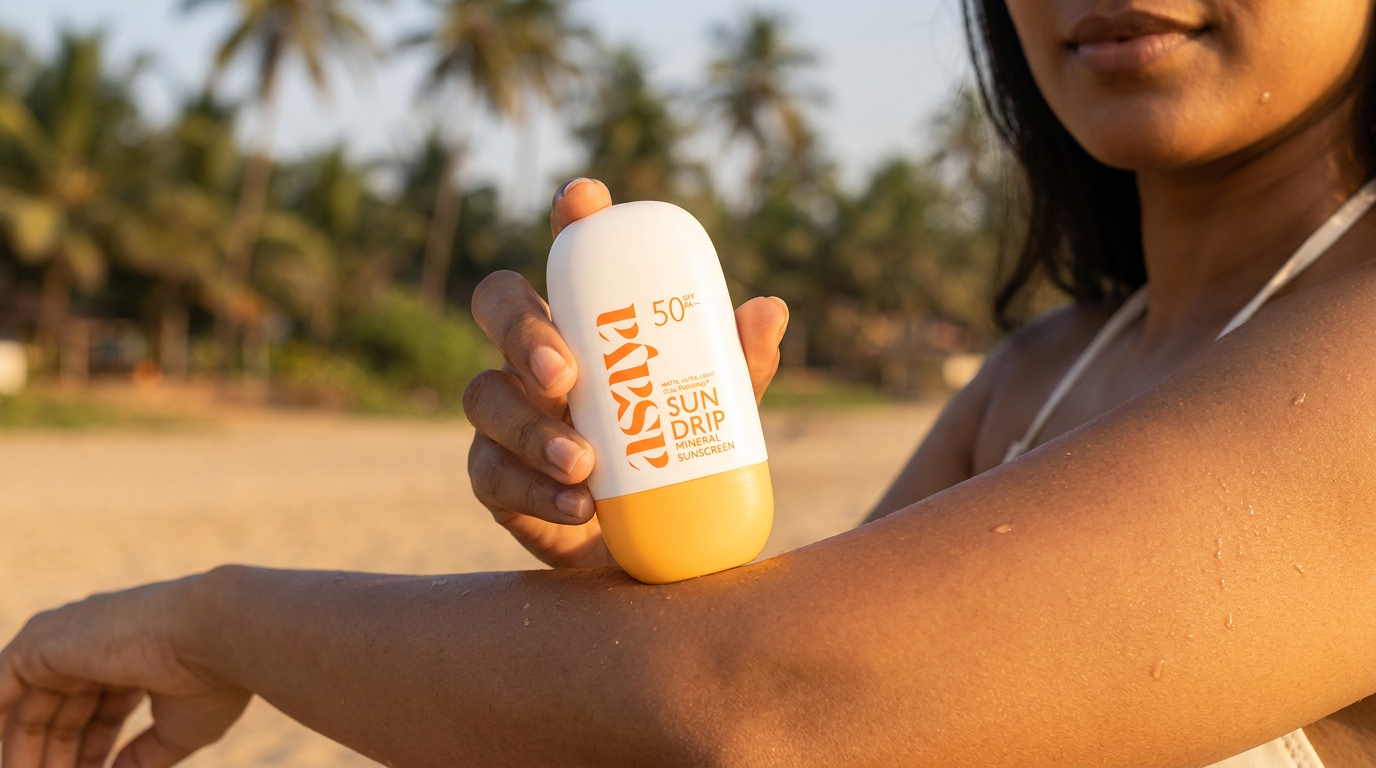
Mineral sunscreens tend to be gentler because they sit on top of the skin rather than being absorbed. The Asaya Sun Drip Mineral Sunscreen uses non-nano Zinc Oxide along with Cica and an anti-pollution complex. It's pregnancy-safe, suitable for reactive skin, and protects against UVA, UVB, blue light, pollution, and heat — which is a lot of coverage in one lightweight formula.
If dark spots and uneven skin tone are your main concern, the Asaya Spot Light Sunscreen SPF 50 PA++++ for Dark Spots and Hyperpigmentation is worth knowing about. It contains the MelaMe™ Complex, Niacinamide, and Licorice Extract — actives that work on existing pigmentation while the SPF prevents new damage. It's a lightweight gel-cream with no white cast, and it's available as a pack of two for ongoing use, which makes it easier to stay consistent without running out.
One application in the morning doesn't last all day. SPF breaks down with sun exposure, sweat, and touch. If you're outdoors or in a humid environment, reapplying every two hours is the standard recommendation. The Asaya Sheerscreen Mist Sunscreen Spray SPF 50+ makes this genuinely easy — it's a clear, quick-drying mist that works on both face and body, is water-resistant for up to 80 minutes, and doesn't disturb your makeup. It's the kind of product that removes the excuse not to reapply.
Sunscreen is the foundation, but it works best as part of a routine that addresses pigmentation from multiple angles. The Asaya Even Tone Face Cleanser — a low-pH gel with the MelaMe™ Complex, Alpha Arbutin, Kojic Acid, and Niacinamide — starts the correction process from step one. Pair it with the Asaya 2% Kojic Acid and 1% Alpha Arbutin Serum for dual melanin-inhibiting actives that are gentle enough for daily use but effective on PIH, sun spots, and uneven tone. If you're also dealing with sun damage and dullness, the Asaya 15% Vitamin C + E Serum with Ferulic Acid works well in the morning before SPF to neutralise free radical damage and brighten existing discolouration. If you'd rather not piece it together yourself, the Asaya Even Tone Restore Set gives you the serum, creme, and SPF in one go — already matched to work together.
Sunscreen prevents UV rays from triggering excess melanin production, which is the root cause of most dark spots and hyperpigmentation. It also stops existing spots from deepening, which means your brightening actives can actually do their job. Without daily SPF, even the best serum is working against UV exposure every morning.
Yes, and it's one of the most important steps in managing it. Melasma is particularly sensitive to UV exposure — even small amounts of sun can trigger or worsen it. Broad-spectrum SPF 50 PA++++ worn daily helps prevent UV from stimulating the excess melanin production that drives melasma. It won't fade existing patches on its own, but without it, no other treatment will hold.
Absolutely. A tinted SPF can actually be helpful because titanium dioxide and iron oxides in tinted formulas provide additional protection against visible light, which can also trigger pigmentation — especially in melasma. The Asaya Hint of Tint SPF 50 Tinted Sunscreen comes in five shades and contains 5% Niacinamide, so it evens out your tone while protecting it. It's a practical option if you want light coverage and sun protection in one step.
For PIH specifically, the Asaya Spot Light Sunscreen SPF 50 PA++++ is a strong choice. It contains the MelaMe™ Complex alongside Niacinamide and Licorice Extract — ingredients that work on existing pigmentation while the SPF prevents UV from darkening those spots further. It's suitable for all skin types and has no white cast, which makes it easy to wear daily.
There's no instant fix for pigmentation, but the fastest visible progress comes from combining daily SPF 50 PA++++ with a melanin-inhibiting serum — like one with Kojic Acid and Alpha Arbutin — used consistently. Most people see a noticeable difference in overall skin tone within 4–6 weeks. Deeper spots take longer, but stopping UV exposure is the single fastest way to stop them from getting worse.
No — sunscreen doesn't bleach or permanently alter your skin tone. What it does is prevent UV from triggering further melanin production, which stops existing spots from darkening and allows your skin's natural cell turnover to gradually fade them over time. The lightening effect you see with consistent SPF use is your skin doing its own work, uninterrupted.
Sunscreen alone won't fade dark spots — it prevents them from getting worse and stops UV from undoing the work your actives are doing. Most people notice their overall skin tone becoming more even within 4 to 6 weeks of consistent SPF use paired with a targeted serum. The spots themselves take longer to fade, depending on how deep the pigmentation is.
Hyperpigmentation is one of those concerns that responds really well to the right routine — but only if you're consistent and patient. Sunscreen is the step that holds everything together. Without it, even the best brightening serum is fighting an uphill battle against daily UV exposure.
If you want to go further, Asaya's MelaMe™ Complex is worth understanding. It's a melanin-first molecule developed specifically for skin like yours — tested and proven to visibly treat discolouration and restore pigment balance within 2 weeks of regular use, a result backed by clinical testing on Indian skin tones. It works by breaking down excess melanin deposits into re-absorbable amino acids, while also inhibiting further excess melanin production, leading to fading of existing spots and more even-toned skin over time. You'll find it in the Spot Light Sunscreen, the Even Tone Face Cleanser, and across Asaya's targeted pigmentation sets.
Dark spots take time to form, so they take a little time to fade too. But with the right SPF and the right actives, you're not just hoping — you're giving your skin what it actually needs.
