


7 Treatments to Get Rid of Pigmentation on Melanin-Rich Skin
Your Cart
0You May Also Like
If you've been dealing with dark spots that just won't budge, you're not imagining it — they really do take longer to fade on melanin-rich skin. Even a small breakout can leave a mark that lasts longer than the breakout itself. That is because your skin makes extra melanin as part of its response to stress. The right hyperpigmentation treatment can help, but harsh shortcuts can also trigger more pigment. A calm routine, sun protection, and the right actives matter most. Asaya formulates its pigmentation care around this reality for Indian, melanin-rich skin.
Start with daily sunscreen and gentle topical actives before stronger treatments.
Peels and lasers need careful dermatologist guidance on darker skin due to PIH risk.
Dark spots are manageable, but ongoing care helps stop their return.
Skin pigmentation happens when one area makes or holds more melanin than the skin around it. Common triggers include acne, rubbing, inflammation, sun exposure, and irritation from strong products.
Post-inflammatory hyperpigmentation, or PIH, often follows acne or a rash. Melasma can appear as broader patches. Sun damage may also cause dark spots and uneven skin tone.
Melanin-rich skin can react strongly to irritation. A treatment that causes burning, peeling, or inflammation may worsen a dark mark. That is why slow changes, gentle use, and consistent SPF are safer than using many strong actives at once.
First, identify the likely trigger. Fresh acne marks need acne control and gentle pigment care. Sun-related skin pigmentation needs sun protection alongside treatment. Deep or spreading patches may need a dermatologist review.
For body hyperpigmentation, friction can be a key trigger. Think elbows, knees, hands, or areas that rub against clothing. Start with a simple routine and assess irritation before adding more products.
Topicals are often the first step in skincare for pigmentation. Hydroquinone may need prescription guidance. Azelaic acid, alpha arbutin, vitamin C, retinoids, and niacinamide are other common options.
Any active can irritate skin if used too often. Introduce one product at a time. The Asaya Advanced Spot Targeting Serum combines 5% niacinamide and 2% alpha arbutin within its MelaMe™ Complex for dark spots, acne marks, tanning, and uneven tone.
Prescription products may be stronger and need dermatologist supervision. Over-the-counter options can suit a daily routine when used as directed. The Asaya 2% Kojic Acid & 1% Alpha Arbutin Serum is designed for daily use on uneven tone, PIH, and melasma-type discolouration.
Glycolic, lactic, and salicylic acid peels remove surface skin cells. They may help dark spot removal, but peel depth matters. Strong or poorly chosen peels can lead to rebound pigmentation.
For melanin-rich skin, a dermatologist should decide whether a peel is suitable and how strong it should be. Do not use a peel on already irritated or peeling skin.
If you do go ahead with a peel, it helps to know what the recovery looks like. Mild peels may cause light flaking for a few days, while stronger ones can mean a week of sensitivity and peeling. Ask your dermatologist what to expect, how to care for your skin in between, and which signs would mean you need to pause treatment.
Laser treatment can target pigment, but it is not automatically right for every dark spot. Heat and inflammation can trigger PIH on darker skin. Ask the dermatologist about their experience with melanin-rich skin and the plan if pigmentation worsens.
A patch test and careful aftercare can be important. Daily sunscreen remains essential after any laser procedure.
It is also worth asking your dermatologist what the recovery period involves and how many sessions are typically needed. Some people see gradual improvement over several weeks, while others may need multiple rounds. Going in with realistic expectations and a clear aftercare plan makes a meaningful difference to the outcome.
A dermatologist may combine topical care, peels, or other in-clinic options such as cryotherapy (a controlled cold treatment). Combination therapy can address both existing pigment and the triggers that create new marks. It also allows the plan to change if your skin gets irritated.
Ask what type of pigmentation you have, what side effects to watch for, and how to protect your skin between appointments.
Aloe vera, turmeric, and potato juice are common pigmentation remedies. They may feel soothing, but they are not a reliable treatment for deep dark spots. Scrubbing, lemon juice, and harsh DIY mixes can irritate skin and make PIH worse.
For a gentle daily base, the Asaya Even Tone Face Cleanser cleanses without stripping and includes MelaMe™ Complex, alpha arbutin, kojic acid, niacinamide, and aloe vera.
A strong skin barrier makes active treatments easier to tolerate. Use a moisturiser if your skin feels tight, dry, or stings. This step matters when you use retinoids, acids, or vitamin C.
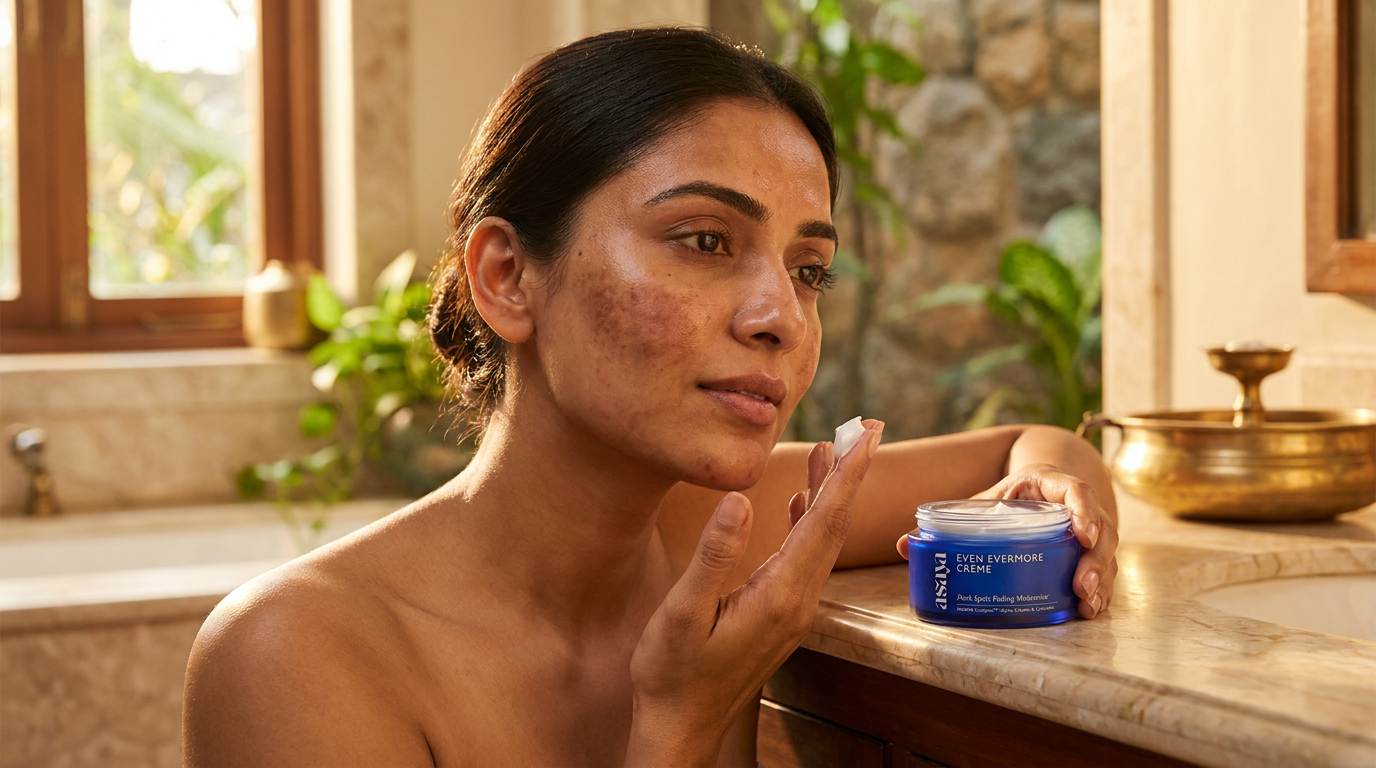
The Asaya Even Evermore Creme pairs ceramides with alpha arbutin and MelaMe™ Complex. It is a daily moisturiser for dark spots, blemishes, and tone imbalance.
Sunscreen is part of every acne marks treatment and melanin reduction plan. UV exposure can darken existing marks and cause new ones. Use broad-spectrum SPF daily and reapply when needed.
Avoid picking acne and stop products that sting or cause a rash. Keep maintenance simple: cleanse, treat, moisturise, and protect.
Most pigmentation is manageable rather than permanently cured. Dark spots can fade, but sun exposure, acne, friction, and irritation can bring new pigment back. Maintenance and trigger control are essential.
A common approach is gentle layering with sunscreen, niacinamide, and low-irritation actives. The same idea can work for melanin-rich skin, but introduce products slowly and focus on avoiding irritation. Asaya's formulation philosophy mirrors this layered, low-irritation approach, designed specifically for Indian, melanin-rich skin.
Consistent daily use of targeted topical actives, combined with broad-spectrum SPF, is the most reliable way to see faster results. There are no true overnight fixes, but with the right routine, visible improvement is possible — Asaya's Advanced Spot Targeting Serum, for example, is formulated to deliver visible results in approximately two weeks of regular use.
Yes. The Asaya 3-Step Spot Diminishing Set combines the Even Tone Face Cleanser, Advanced Spot Targeting Serum, and Even Evermore Creme for a cleanse, treat, and hydrate routine.
What is the best treatment to get rid of pigmentation? It is usually a steady plan, not one aggressive step. Begin with sunscreen, add one suitable active, and seek dermatologist advice for stubborn, deep, or changing patches.
MelaMe™ Complex is Asaya's advanced skincare-engineered, melanin-first molecule. It is designed to visibly treat discolouration and restore pigment balance within approximately two weeks of regular use, and is tested and proven. It breaks excess melanin deposits into re-absorbable amino acids while helping inhibit excess melanin production. This helps fade existing blemishes and support a more even-looking tone.
