


How to Identify Your Skin Type at Home
Your Cart
0You May Also Like

₹599 ₹749

₹424 ₹499

₹479 ₹599

₹559 ₹699

₹424 ₹499

₹439 ₹549
You wash your face, and within an hour it feels tight. Or maybe your cheeks look a little dull no matter how much water you drink. Dryness is one of those skin concerns that sneaks up quietly, and it can be easy to confuse with other skin types or dismiss as just a seasonal thing. Knowing how to identify your skin type is the first step toward building a routine that actually works for you. If you've been wondering how to tell what skin type you have without having to go to a dermatologist, the bare-face test is the most reliable place to start — and it's also something Asaya's formulations are built around, products designed for real Indian skin, not a generic skin type chart.
TL;DR
Dryness can be a skin type (dry skin) or a temporary condition (dehydration) — they need different fixes.
Learning to identify your skin type at home helps you choose the right products and avoid making dryness worse.
The right cleanser, moisturiser, and sunscreen can go a long way in managing dryness without overcomplicating your routine.
Dryness happens when your skin doesn't produce enough natural oils, or when its moisture barrier is compromised. This is different from dehydration, which is a lack of water in the skin and can affect any skin type, including oily skin. Dry skin, as a skin type, tends to feel tight, look flaky, and sometimes feel rough to the touch. It's a characteristic that stays fairly consistent across seasons, though it can worsen in winter or air-conditioned environments.
The simplest method for a skin analysis at home is the bare-face test. Wash your face with a gentle cleanser, pat dry, and wait 30 minutes without applying anything. If your skin feels tight, looks dull, and shows no shine anywhere, you likely have dry skin. While skin type quizzes online can give you a starting point, the bare-face test is more accurate because it's based on how your actual skin behaves, not your answers to general questions.
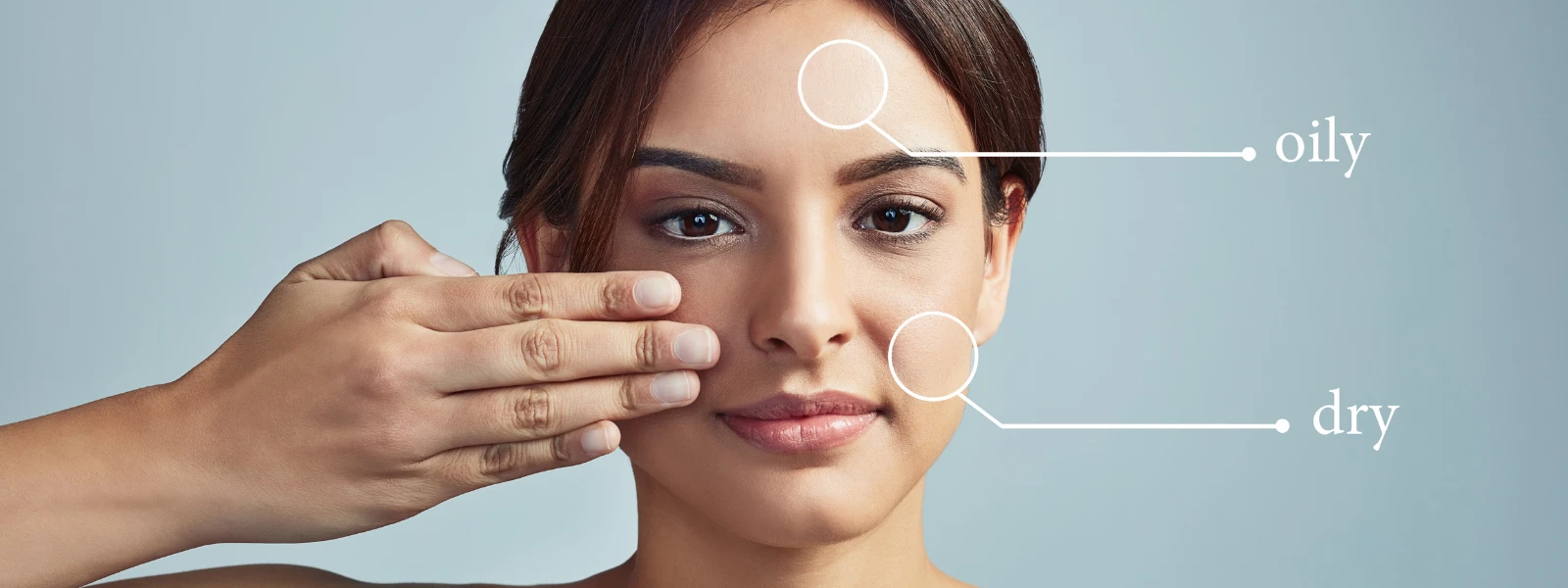
Dry skin identification gets tricky because some people have combination skin, where the T-zone is oily but the cheeks are dry. Others have skin that's temporarily dehydrated due to weather, stress, or a harsh product. In India especially, seasonal humidity shifts can make it genuinely difficult to read your skin correctly — what feels dry in winter may behave very differently in a humid monsoon month. Understanding these patterns before reaching for products helps you avoid routines that work against your skin type rather than with it. Here's a quick breakdown to help you figure out what you're working with.
Skin feels tight after cleansing. Little to no shine even by midday. May show flaking or rough patches, especially around the nose and cheeks. Pores appear small or barely visible.
Oily or shiny in the T-zone (forehead, nose, chin) but dry or normal on the cheeks. This is one of the most common skin types, especially in urban Indian climates where humidity varies a lot.
Skin looks shiny all over within an hour or two of washing. Pores appear larger, and breakouts are more frequent. Even oily skin can feel dry if stripped by harsh cleansers, so the type of product you use matters.
You don't need a ten-step routine to manage dryness well. Three consistent steps, done daily, make the biggest difference: cleanse gently, moisturise while your skin is still slightly damp, and protect with sunscreen every morning. When the moisture barrier is consistently supported, skin holds onto water better, responds to actives more effectively, and looks more even and calm over time. If you're looking for a starting point that covers all three, the Asaya Better Daily Essentials set includes the Even Tone Face Cleanser, Moisture Cocoon, and Spot Light Sunscreen. The Moisture Cocoon in particular works well for dry skin because it focuses on hydration and barrier support without feeling heavy or greasy.
If dryness is also showing up on your body — especially on knees, elbows, and neck — the Asaya Tone Restore Knee-Neck-Elbow Cream is formulated with Urea, which draws moisture in and helps soften texture, along with AHAs to gently exfoliate dead skin buildup.
The bare-face test is the most straightforward method. Cleanse your face, wait 30 minutes without applying anything, then observe. Tight and dull means dry. Shiny all over means oily. Shiny in the middle but dry on the sides means combination. This gives you a reliable baseline to work from at home, no clinic visit required.
Dry skin is a skin type — it's about oil production and tends to be consistent. Dehydrated skin is a condition — it's about water content and can affect any skin type.
If your skin feels tight and looks dull even after drinking enough water and using a moisturiser, it's more likely a dry skin type. If the tightness comes and goes with seasons or stress, dehydration is more likely the cause.
The 4-2-4 rule refers to a cleansing method: massage an oil cleanser onto dry skin for 4 minutes, emulsify with water for 2 minutes, then rinse with a water-based cleanser for 4 minutes. It's designed to thoroughly remove sunscreen and buildup without stripping the skin. For dry skin types, this method can be useful occasionally, but a gentle single cleanse is sufficient for daily use.
Truly normal skin — balanced, neither oily nor dry, with minimal sensitivity — is considered the rarest skin type. Most people fall somewhere on the spectrum of dry, oily, or combination, which is why personalised routines matter more than one-size-fits-all advice.
Dryness is one of the more manageable skin concerns once you understand what's actually going on. Whether it's your skin type or a temporary condition, the fix usually starts with a gentle cleanser, a good moisturiser, and consistent sun protection.
If pigmentation is also part of the picture, Asaya's MelaMe™ Complex is specifically designed for melanin-rich skin, working by breaking down excess melanin deposits and inhibiting further overproduction. In clinical testing, MelaMe™ Complex showed visible fading in approximately two weeks of consistent use — making it a practical complement to a hydration-first routine for dry skin dealing with both texture and tone concerns.
